Wednesday, September 8, 2021

Exploring Minnesota - Minnesota River Valley Trip - Pipestone

We set out for the southwest corner of Minnesota to begin our trip down the Minnesota River Valley.  Our first stop was Pipestone.

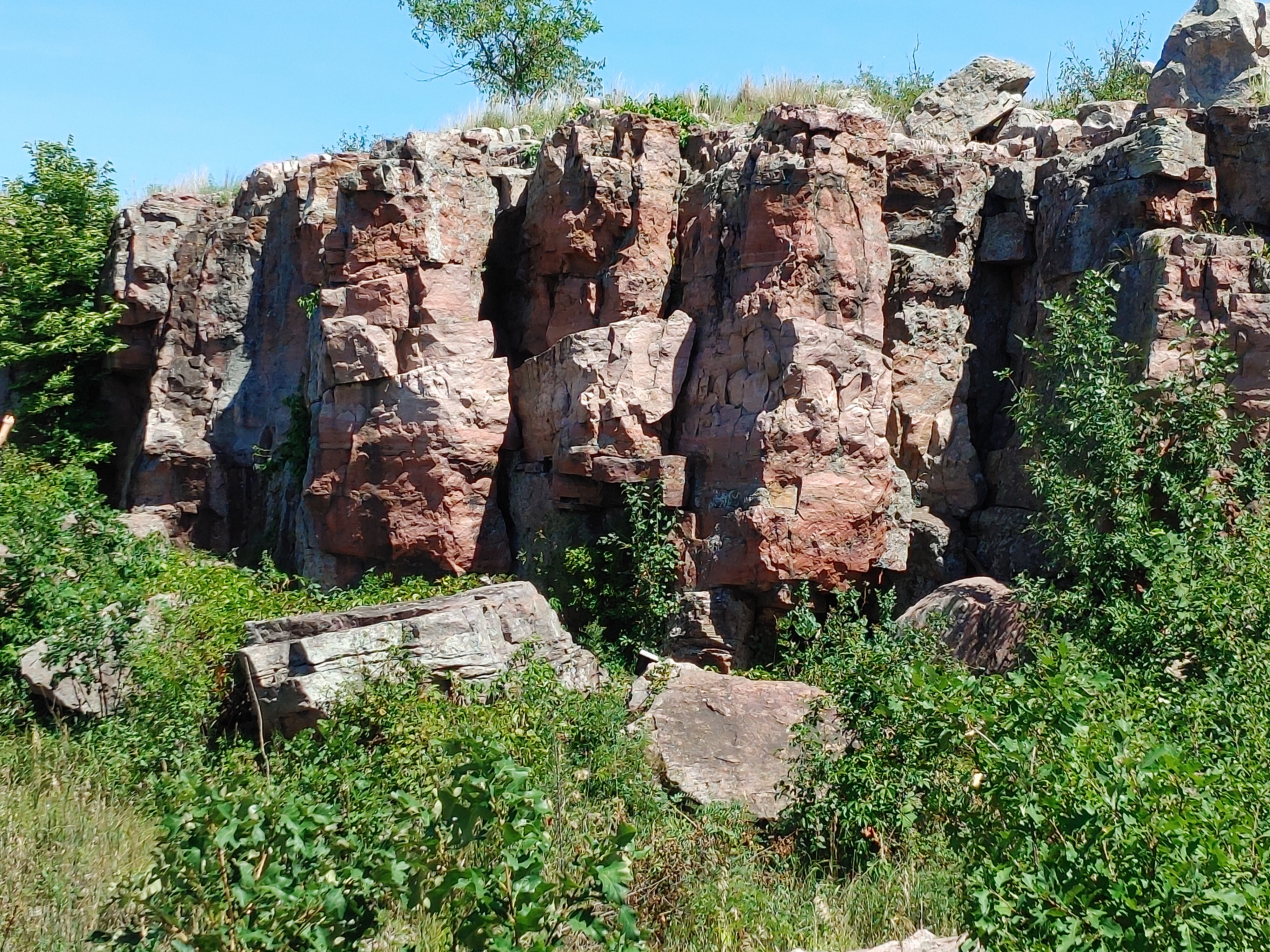
It is a sacred place for many.  The Native Americans came to this place to quarry the rock used for pipestones.  The quarry is operational to this day.


There is a visitor center and a long trail through the quarry area.  The visitor is reminded that buffalo roamed this area and there are exhibits of prairie grasses of the Great Plains.


It is interesting that there is this one place where the red rock appeared.


As we walked the trail, I told Dianne I was on a mission.  I told her of my childhood visit to this place.  My uncle had teased me and my cousins about leaping out on a certain rock along the trail.  Could I find the rock?  Yes, we came across "leaping rock" and you can see from these pictures that the leap is dangerous.


Over the centuries, Pipestone Creek wore down the rock cliffs exposing the special rock.  Buffalo paused to drink along the creek.


The trail was very interesting and included caves and waterfalls.


Next stop, Walnut Grove, childhood home of Laura Ingalls Wilder.


Saturday, August 7, 2021

Monsters on the Great Plains

There are monsters prowling about upon the Great Plains. You will see them here in this post.


I grew up with tractors.  My grandfather Johnson owned a farm implement dealership at Chokio, Minnesota.  When we were little kids, my cousins (Chuck and Randy) and I terrorized his employees in the shop.  The only place off limits for us boys was his office.  We were just youngsters when we "drove" tractors on the showroom floor.  

There were big hoists in the shop that were used to lift engines out of tractors.  Grandfather's mechanics must have looked on in horror as one of us youngsters grabbed the hook on the hoist to be lifted toward the ceiling by the other two of us.  Somehow we lived through those years.

The implement buildings are gone now, at Chokio, but the memories live on.

There is something about tractors.


My grandfather would not have recognized the tractor cab of today.  Air conditioned, with stereo, and computers as shown in this picture.


These tractor pictures were taken today at the Pope County fair at Glenwood.  


We have been experiencing small-town life this summer.  First there was the 4th of July celebration at my hometown of Hancock.  We took in the parade then drove over to Starbuck for another parade.  The Waterama celebration at Glenwood served up a third parade and a water show.  Now it is the season of the county fairs.  Then comes the big one in September, the Minnesota State Fair.

You can take the boy out of Minnesota but you can't take the Minnesota out of the boy.

I was told the men in grandfather's shop made this car for me, complete with horn and pedals.


Tuesday, July 6, 2021

Cabin Update

We decided we wanted to make our cabin more livable, inside and out, for 2021.  Here are the results.

First, here is the complete picture.


We added new pavers and built in a parking place close to the cabin.  Our car, as pictured, is in our guest parking spot.  Note the new skirting on the cabin and the lake in the background.


The new skirting shut out the racoon family living beneath the cabin.  Those little racoons were cute, but had to go.  New flower pots break up the long lines of the side of the cabin.


Indeed, we added several flower pots this year.


We added a table with six chairs as well as a storage box immediately behind it.


The new firepit serves as a table for our wine glasses when we enjoy the sunsets over Lake Minnewaska.


Inside the 3-season porch we added new curtains and an armoire to hold our seasonal clothing.  We spend a great deal of our time in those recliners.


These updates have resulted in our spending more time on the patio this year.  These are the views we enjoy.

The park with creek running through it and into Lake Minnewaska.


Looking back at our cabin from the park and creek.  Our neighbors cabin is on the left.  There are 12 cabins and we are fortunate to be closest to the lake.


The creek is running dry because of the drought.  Note the bridge over the creek.  There are a couple miles of trails through the 420 acres of our resort.


There is a picnic area between us and the lake.  Beyond that is the marina for some 20 of our boats.


We close out this post with the big bonus we found about after we moved in, the great sunsets over Lake Minnewaska.


Monday, June 28, 2021

Video - Lake Minnewaska Sunsets

Pictures set to music, what a way to enjoy the sunsets of Lake Minnewaska.  Turn up your volume and watch this on your big screen please.


Saturday, June 26, 2021

Indian Schools Revisited

I write this report today because of a monument I found today in the cemetery near Clontarf.  See picture below.

Last year I wrote about the Indian Boarding Schools, in particular the school at nearby Clontarf.  The Great Northern Railroad brought native youth from the plains to the schools so that they could become “civilized”.

This is what achieving civilization looked like in practice: Students were stripped of all things associated with Native life. Their long hair, a source of pride for many Native peoples, was cut short, usually into identical bowl haircuts. They exchanged traditional clothing for uniforms and embarked on a life influenced by strict military-style regimentation. Students were physically punished for speaking their Native languages. Contact with family and community members was discouraged or forbidden altogether. Survivors have described a culture of pervasive physical and sexual abuse at the schools. Food and medical attention were often scarce; many students died. Their parents sometimes learned of their death only after they had been buried in school cemeteries, some of which were unmarked.

Minnesota had sixteen boarding schools that drew students from all eleven of the state’s reservations. The earliest was White Earth Indian School, begun in 1871. In 1902, St. Mary’s Mission boarded an average of sixty-two students, Red Lake School seventy-seven, and Cross Lake forty two. At Morris, more than two thousand children attended the school during its history. White Earth had room for 110 students. Clontarf housed an average of 130 children from reservations in Dakota Territory. By 1910, Vermilion Lake held 120 students. Cass/Leech Lake opened with a capacity of fifty students. Pipestone housed children from Dakota, Oneida, Pottawatomie (Bodéwadmi), Arikara, and Sac and Fox (Sauk and Meskwakwi) tribes.

Methods of discipline at Minnesota boarding schools were harsh. Some schools had cells or dungeons where students were confined for days and given only bread and water. One forced a young boy to dress like a girl for a month as a punishment; another cut a rebellious girl’s hair as short as a boy’s. Minnesota boarding schools recorded epidemics of measles, influenza, blood poisoning, diphtheria, typhoid, scarlet fever, tuberculosis, pneumonia, trachoma, and mumps, which swept through overcrowded dormitories. Students also died from accidents such as drowning and falls.

The monument I spotted today denotes the burial site of fourteen students of the Clontarf school.  They were of the Sioux and Chippewa Nations.


Thursday, June 17, 2021

Sunset of June 17


“Every sunset brings the promise of a new dawn.” – Ralph Waldo Emerson


“A sunset paints the sky as if there were no tomorrow.” – Anthony T. Hincks


 “If you are in a beautiful place where you can enjoy sunrise and sunset, then you are living like a lord.” – Nathan Phillips


 “When your world moves too fast and you lose yourself in the chaos, introduce yourself to each colour of the sunset.” – Christy Ann Martine


 “No sun outlasts its sunset, but will rise again and bring the dawn.” – Maya Angelou


 “Sunsets, like childhood, are viewed with wonder not just because they are beautiful but because they are fleeting.” – Richard Paul Evans


“O, Sunlight! The most precious gold to be found on Earth.” – Roman Payne


“Sunsets are proof that no matter what happens, every day can end beautifully.” – Kristen Butler


“Dawn and dusk are mutual friends of the sun; one opens the door for him to a brand new day and the other one has to shut it to embrace the darkness of night.” – Munia Khan


“Bursts of gold on lavender melting into saffron. It’s the time of day when the sky looks like it has been spray-painted by a graffiti artist.” – Mia Kirshner


“The sun was a fiery furnace of gold, but finally it set in the west and the cosmos glittered like a million burning embers, briefly reminding Awa of poetry readings under starry skies in Timbuktu.” – Rehan Khan


If you like Sunrises too, you will like this Donovan tune.

Colours